






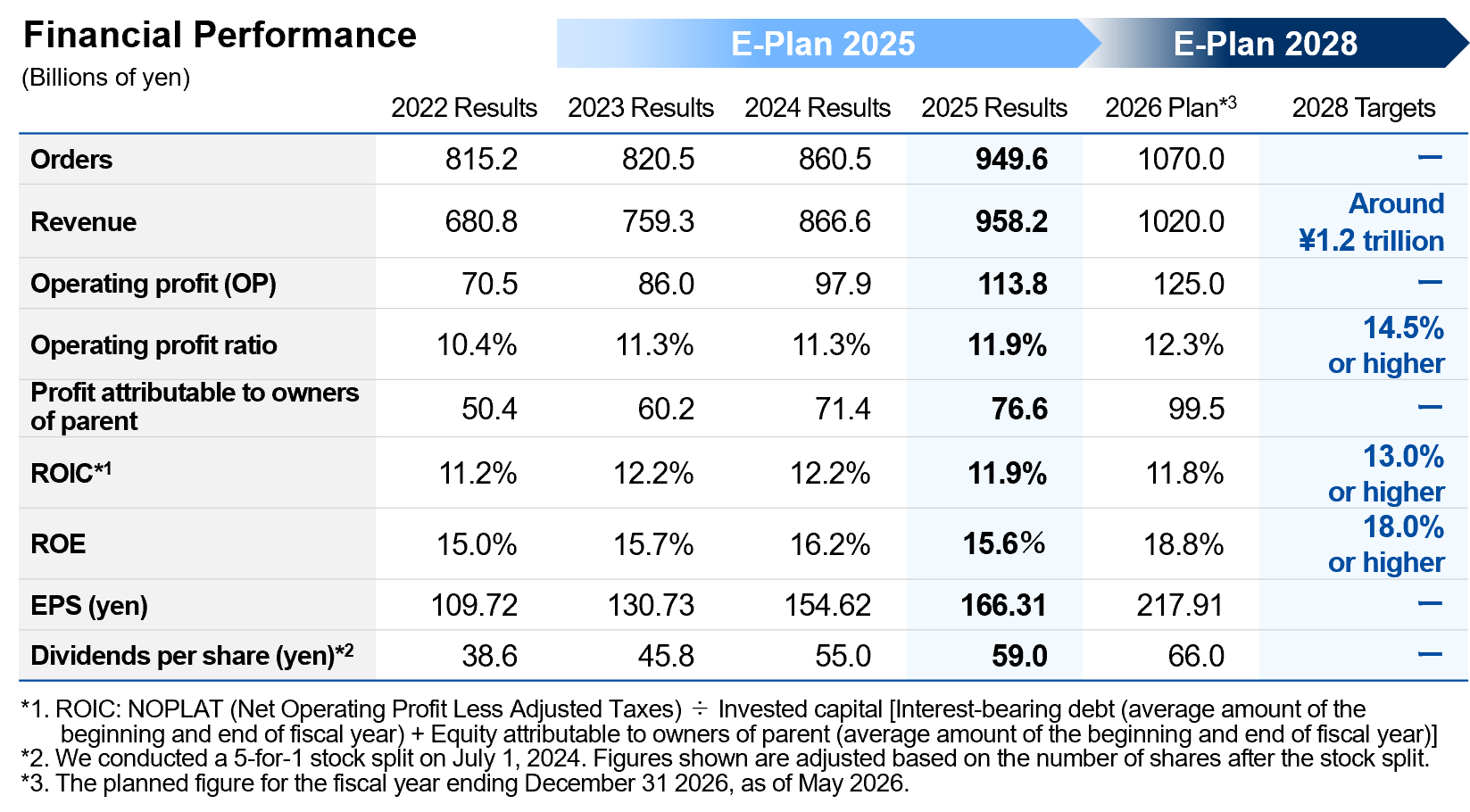
Looking back on the three years of E-Plan 2025, the greatest achievement was that we were able to steadily improve efficiency (capital efficiency) and profitability (operating profit ratio) while simultaneously achieving growth (revenue). We have operated with the belief that improving efficiency and profitability should take top priority, and that revenue growth would follow as a result. Consequently, our pursuit of quality led to improvements in both quality and scale, enabling us to achieve increases in both revenue and profit. We believe this was the result of the steady efforts accumulated by each division with customer-centered value creation in mind, and that these were three valuable years.
Message from the CFO
Enhancing efficiency and profitability to power the next decade, we will accelerate growth toward E-Vision 2035.
Results of the Three Years of E-Plan 2025
Achieving efficiency and profitability, as well as growth
Challenges Over the Three Years of E-Plan 2025
Establishing a global management foundation and advancing investment management are prerequisites for the next stage of growth
While we achieved results, there are also challenges to address in light of future growth.
The most significant theme is strengthening our global management foundation. In particular, the implementation and establishment of the ERP system remains the highest priority issue, and we must ensure its successful completion in order to maximize the effectiveness of our next growth initiatives. The key issue in ERP implementation lies in defining the scope of standardization. Across the Group, the nature of products and projects handled by each business, lead times, and business practices differ significantly, and one of our strengths is our ability to provide customized solutions tailored to the differing needs of each customer. At the same time, as we advance standardization on a global basis, it is essential to clearly define what should be standardized and where uniqueness should be retained. We must eliminate what is unnecessary while preserving the strengths that define us. Currently, we are shaping the management foundation that will support our future competitiveness by carefully making these decisions step by step.
Another challenge is establishing a cycle for the in-depth examination, prioritization, and evaluation of investment projects. During the period of E-Plan 2025, we steadily executed the planned investments. We recognize that the themes to be addressed over the next three years are the proactive pursuit of investment opportunities, expansion of the investment project pipeline, rigorous prioritization from the perspective of economic value, disciplined execution and post-implementation evaluation, and the establishment of such an investment management cycle.
Formulation of E-Vision 2035
Enhancing economic value starting from social value
In E-Vision 2035, the new long-term vision announced in February 2026, we clearly set forth the concept of building economic value through the creation of social and environmental value. Fortunately, our core businesses themselves are directly linked to solving social issues. By making the most of this advantageous position, we will pursue initiatives through our core businesses that create value for society and the environment, and use the economic returns generated as a result to raise profitability and efficiency to a high level—this is the core financial philosophy underlying E-Vision 2035. Accordingly, we are also advancing initiatives to quantify our contributions to society and the environment through our businesses and to calculate the associated financial impact.
E-Plan 2028 Cash Allocation and Investment Management
Concentrating enhanced cash generation capabilities on growth investments
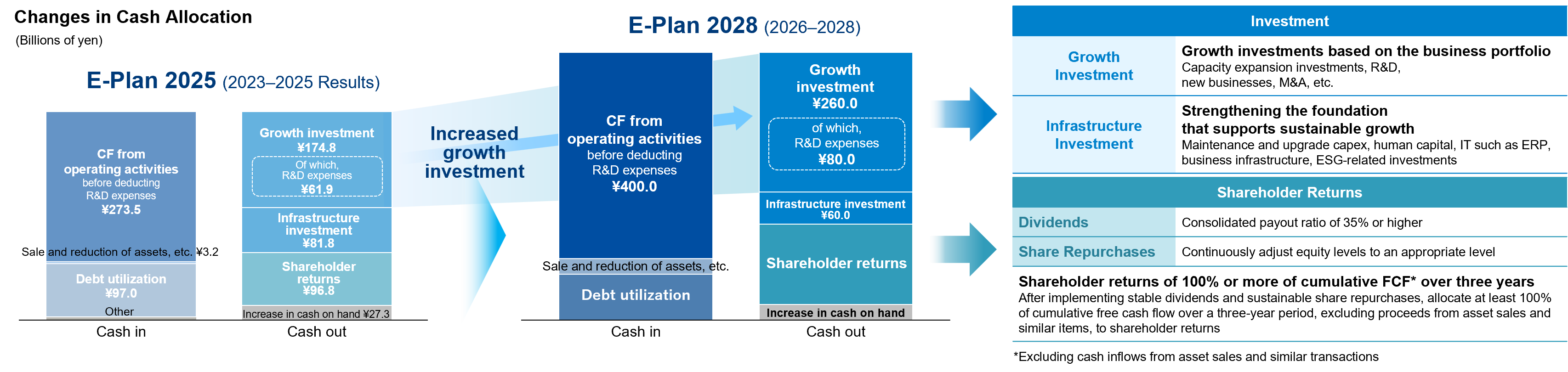
Cash allocation under E-Plan 2025 was largely in line with our plan. On the cash inflow side, improved profitability across our businesses led to a structural strengthening of our operating cash flow generation capacity. As a result, we established a framework capable of generating approximately ¥270 billion in cash cumulatively over the three-year period, or about ¥90 billion per year on average. On the cash outflow side, expenditures were executed generally as planned, and the cash generated was appropriately allocated to both growth and infrastructure investments.
E-Plan 2028 is positioned as a phase in which, with a view toward the next 10 years, we will further strengthen our cash generation capabilities to steadily accumulate operating cash flow and proactively allocate it to growth and infrastructure investments, with a particular emphasis on the former. Addressing debt utilization, we established levels we believe are optimal by considering both the ROE spread and the ROIC-WACC spread.
On the cash inflow side, we will steadily capture returns from past investments and expand operating cash flow to approximately ¥400 billion cumulatively over the three-year period. As the profit contribution from the highly cash-generative Precision Machinery business increases, our overall operating cash flow is expected to continue increasing.
On the cash outflow side, we plan to direct ¥260 billion cumulatively over the three-year period to growth investments centered on the three global business segments, including production capacity expansion, research and development, new businesses, and M&A. At the same time, we plan infrastructure investments of ¥60 billion in areas including maintenance and replacement facilities, human capital, IT, such as the ERP system, business infrastructure, and ESG-related initiatives.
In addition, one of the objectives of our growth investments is to expand our business domains. We see M&A as one means of achieving this, not as an end in itself, but as an option to be used when it represents the most effective way to move into higher-value-added areas. In making investment decisions, we assess appropriateness against business- and region-specific hurdle rates, while also applying disciplined criteria to avoid overly optimistic assumptions regarding synergies. We also recognized that the success of M&A ultimately depends on post-investment management. Accordingly, we treat the process, from initial evaluation through PMI, as a single, integrated effort, with close collaboration between business divisions and the CFO line. If progress does not unfold as planned, we will review and refine our approach as needed. We remain committed to seeing each investment through until the acquired business is fully integrated and can contribute as a genuine part of our organization.
In formulating E-Plan 2028, we also reviewed the business-specific and region-specific hurdle rates for investment projects to reflect changes in risk premiums and rising market interest rates. We will continue to place importance on maintaining strict discipline in pursuing returns that exceed the cost of capital.
At the same time, we will also utilize debt as part of optimizing our capital structure. Our policy is to manage this under the financial discipline of maintaining the D/E ratio within a range of 0.4 to 0.5. The underlying rationale is the belief that, from the perspective of enhancing corporate value over the medium to long term, it is important to improve both the ROE spread and the ROIC-WACC spread. While one possible approach to pursuing only the ROE spread would be to continuously increase leverage, we believe this would lead to higher debt costs and, as a result, would not contribute to improving the ROIC-WACC spread.
Please also note that, in our cash allocation chart, research and development expenses are presented as being included within cash inflows and cash outflows based on the concept that such expenses are intentionally allocated toward future growth.
Advancement of ROIC Management
An investment strategy that balances growth and discipline
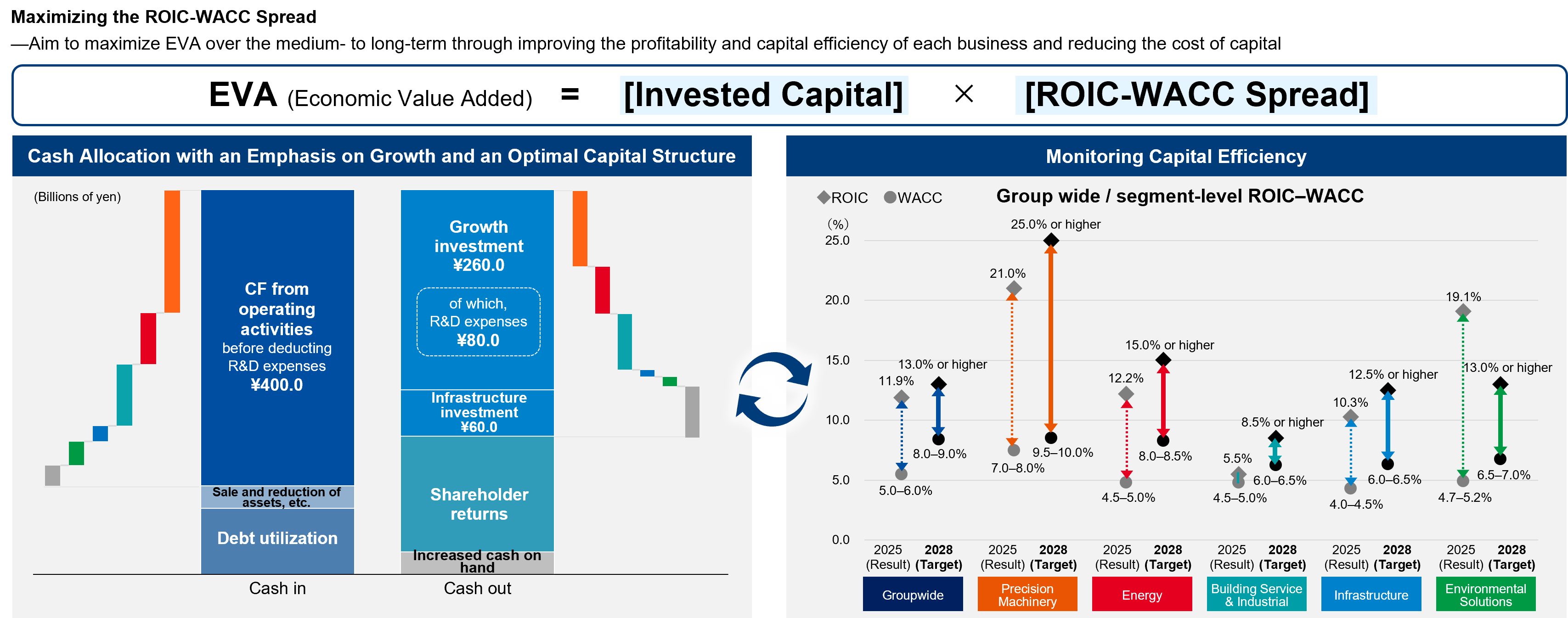
What the Group truly aims to achieve through ROIC management is not merely the pursuit of the ROIC-WACC spread, but rather the maximization of EVA, the absolute indicator of corporate value, while maintaining the discipline represented by the spread.
Excessive pursuit of the spread alone could lead to an overconcentration on highly profitable existing businesses and suppress investments for future growth, creating the risk of falling into a so-called contraction equilibrium. Accordingly, in the current medium-term management plan, we have clarified an investment process in which we monitor the spread of each business as an efficiency indicator while reallocating the cash generated by each business in a disciplined manner to growth areas expected to contribute to future EVA expansion.
From this perspective, we allocate resources in line with the characteristics of each segment. For example, in the two Japan-centered businesses, Infrastructure and Environmental Solutions, we have already secured sufficient ROIC-WACC spreads; however, given the maturity of these markets, additional investments offer limited EVA upside. In contrast, our three global business segments operate in growth markets and present significant opportunities to expand EVA through further investment. With a clear focus on the time horizon, we will prioritize capital allocation to areas with strong market potential and a high capacity to contribute to the Group’s overall earnings.
Strengthening operational discipline and pursuing overall optimization
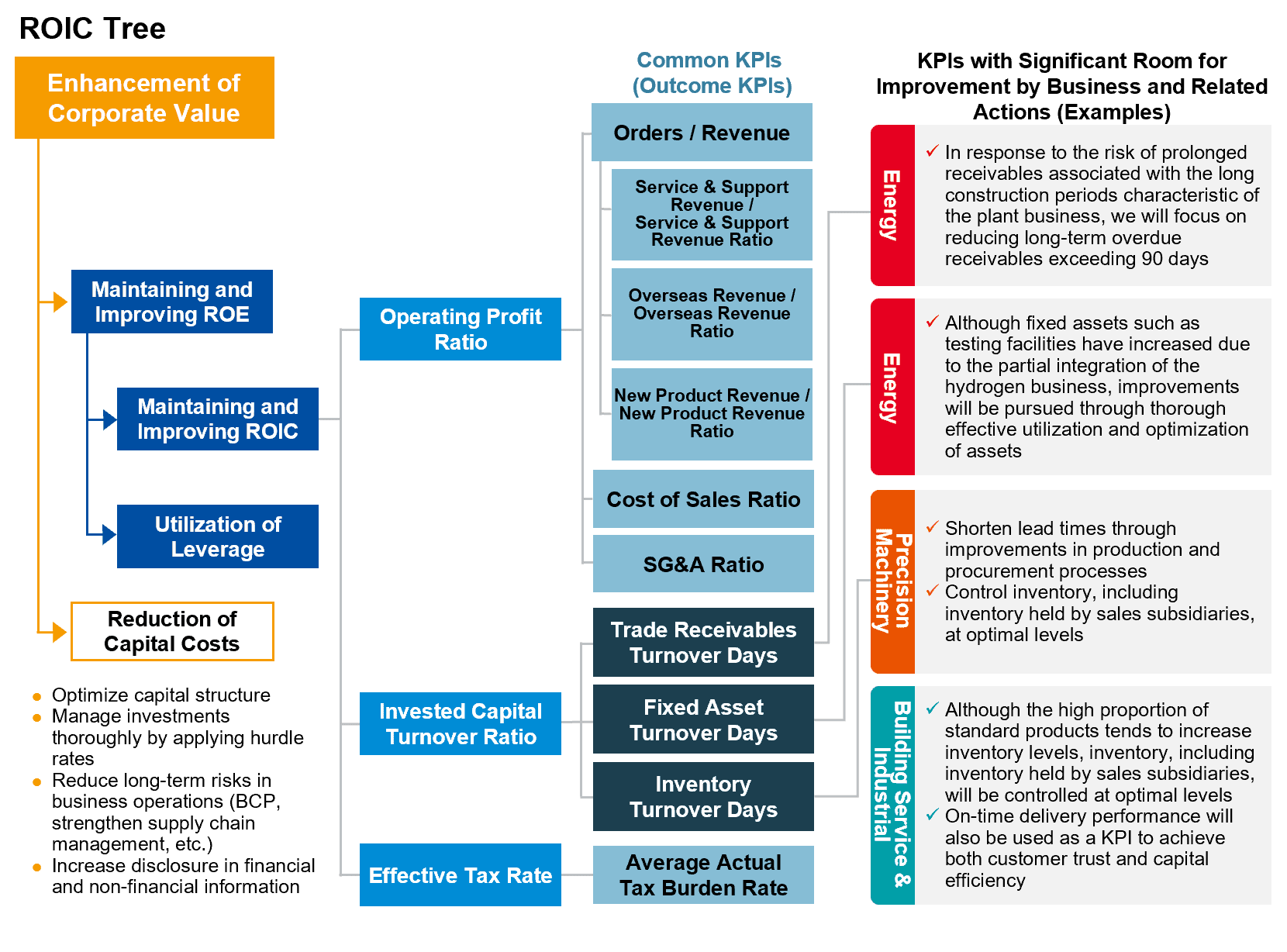
In our efforts to improve ROIC across each business, we have promoted ROIC management throughout the organization without imposing excessively detailed KPIs at the operational level. Excessive focus on granular asset allocation can lead to overly fine, unproductive discussions. Instead, we have found that maintaining a broader perspective and tracking trends over time has been an effective approach. As a result, awareness of profit generation and the management of total invested capital has become more firmly embedded across the organization.
However, while progress has been made in controlling inventories and trade receivables at the subsidiary level, we have not yet reached the stage of optimizing operations globally from the perspective of the business as a whole, such as determining where and how inventories should be optimally managed and how order and sales forecasts should be linked with inventory management. Awareness of reducing invested capital within each individual area of responsibility has taken root, but the challenge going forward is to elevate this to the next level and achieve overall optimization across the business as a whole.
To achieve overall optimization, we place strong emphasis on our dialogue with business divisions, particularly by focusing on medium- to long-term perspectives, such as what actions are needed today to meet ROIC targets over the next three years. This reflects our view that the priority is not improving short-term results through temporary measures but strengthening the underlying fundamentals of the business. In this sense, we see the essence of ROIC management as maintaining a long-term perspective and consistently taking actions that will lead to favorable spreads in the future.
Reducing WACC through dialogue with the capital markets
The role of the IR function is extremely important in reducing WACC. First, it is essential to disclose our business and financial position appropriately and transparently. In addition, we must sincerely engage with feedback received from the capital markets and continue careful dialogue, including discussions regarding timing and conditions, even when we are unable to provide clear answers immediately. We believe that by carefully incorporating such feedback internally and repeatedly implementing concrete improvements, understanding of Ebara will deepen, ultimately leading to a reduction in WACC.
Maximizing Shareholder Value
Delivering value at the intersection of the capital markets and business markets (product and service markets)
Delivering the value created through efficiency, profitability, and growth to shareholders and investors is one of my key responsibilities, while also meeting the expectations of all stakeholders. Our dividend policy is to maintain a payout ratio of at least 35%, even during this growth phase. In addition, after securing solid operating cash flow and making the investments needed for growth, we aim to return more than 100% of cumulative free cash flow over the three-year period, excluding proceeds from asset sales.
We will also evolve our approach to shareholder returns. In the past, we conducted share repurchases once every few years, but going forward, our policy is to execute them in a more agile and consistent manner. We believe we are in a phase of continued earnings growth and accumulation of shareholders’ equity. After allocating cash generated to growth investments, if there are no further investment opportunities remain, we will promptly return excess capital to shareholders. We are committed to delivering stable shareholder returns over the next three years.
Since assuming the role of CFO, I have often been asked by investors why Ebara operates five businesses within a single corporate structure. While there are factors such as shared technologies and customer bases, from a financial perspective, I would emphasize the benefits of portfolio diversification, businesses with different market characteristics and cycles supporting one another both financially and strategically. In particular, this structure provides flexibility through internal financing. The Precision Machinery business, for example, is subject to higher volatility and has at times required significant upfront investment to respond to rapid demand growth in semiconductor-related markets. In such cases, we have been able to support its expansion by reallocating stable cash flow generated by other businesses. While external financing is always an available option, we believe that this financial flexibility contributes to stable growth. At the same time, we will continue to regularly assess whether we remain the best owner of each business.
As a result of these initiatives, we recognize that the conglomerate discount has been trending downward. The five businesses are increasingly being evaluated not as standalone entities, but in terms of the synergies they generate. Continuing to communicate this value to the capital markets is one of my important roles as CFO. Communicating capital market feedback internally while demonstrating internal transformation to the capital markets, standing at this intersection, I feel a strong sense of both responsibility and purpose.
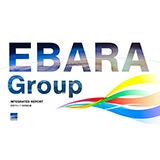
Total Shareholder Return Logic Tree
We place importance on total shareholder return (TSR) as a key indicator of shareholder value creation. Together with ROE, which is a key financial target, we break down TSR into its key drivers and promote improvements by linking them to specific initiatives. While maintaining an awareness of our PBR level, we will work to enhance ROE and maximize TSR over the medium to long term.