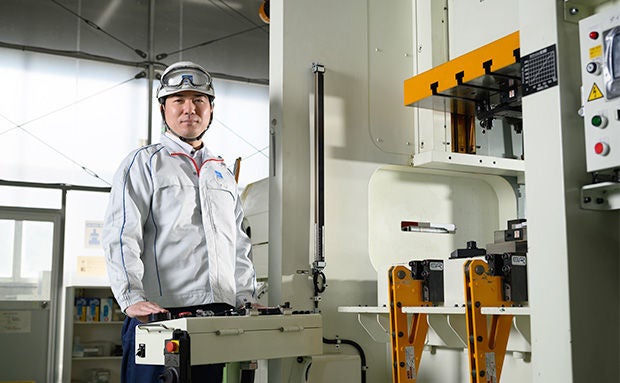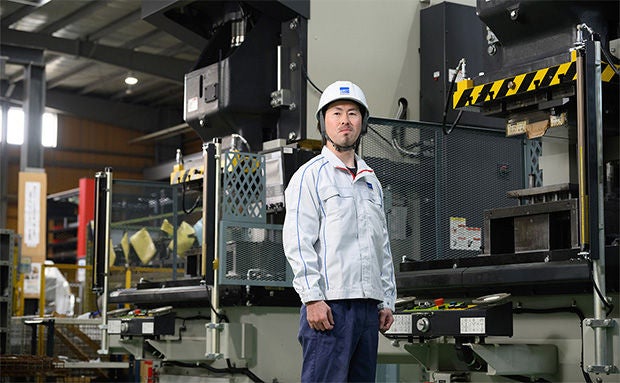







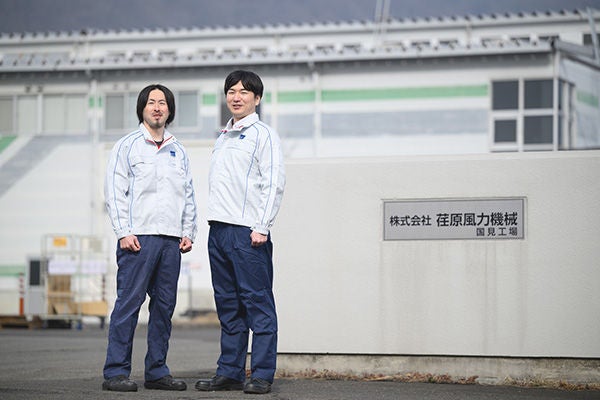
Kunimi Factory of EBARA FAN & BLOWER manufactures fans used in buildings and commercial facilities. Here, a project is underway to reduce the workload of increasing operators due to the expansion of in-house production of pressing, aiming for reduced man-hours, cost savings, and manufacturing process improvements. This is a collaborative effort between the Ebara Manufacturing Technology Advanced Center (EMTAC), which supports “monozukuri” for the entire EBARA Group, and the members of Kunimi Factory. What kind of project was it? ―Yuichi Matsui, who is a member of EMTAC, from the Press Team, Prototype & Manufacturing Collaboration Section, Manufacturing Technology Development Department, Innovative Production Engineering and Quality Assurance Division, and Junpei Uta from the Procurement Physical Distribution Section, Production Department at EBARA FAN & BLOWER's Kunimi Factory shared their insights.
Improvements Born From the Fusion of On-site Insight and Data: Boosting Press Efficiency Through EMTAC and Kunimi Factory Collaboration
Developing unique dies to aim for process reduction and stable production
Developing Unique "dies" for the Press to Reduce On-site Burdens
―― What kind of initiatives were taken to reduce man-hours in the pressing process by EMTAC and Kunimi Factory?
Uta:Kunimi Factory produces fans, and particularly for medium and small-sized products, there is a manufacturing process called pressing. This was an initiative to streamline that process.
Matsui:Pressing is a processing method where a metal plate is placed in a dedicated die and pressure is applied from above using a machine called a press to shape it into the desired form. The pressure can reach several tens to hundreds of tons and is used in many products, including automobiles.
Currently, I am accumulating know-how on pressing at EMTAC and supporting various EBARA Group districts based on that. The initiatives at Kunimi Factory were one of those efforts.
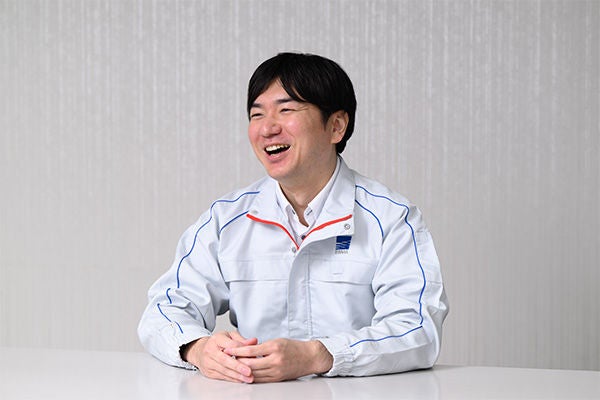
Press Team, Prototype & Manufacturing Collaboration Section, Manufacturing Technology Development Department, Innovative Production Engineering and Quality Assurance Division
Uta:In pressing, to shape the metal into the desired form, the first die is applied to flatten the metal into a cylindrical shape, and then the second die is used to create steps in certain areas, using several types of dies to deform it each time. At Kunimi Factory, there were products that required up to six types of dies to achieve the desired shape, meaning "six processes" were necessary. I consulted Matsui san to see if we could reduce the number of processes even slightly.
Matsui:Since the die is changed for each process in pressing, reducing even one will lessen the burden on- site and also reduce labor costs (personnel expenses related to manufacturing). Additionally, by reducing the number of dies used, we can also keep development costs down. As a result, we developed a die that can complete the two intermediate processes at once, allowing us to reduce from six processes to five, ultimately leading to a reduction in lead time.
Uta:Dies require regular maintenance, but the ones we were using were made by an external company, and during maintenance, we had to entrust them to that company. Therefore, during this period, we could not perform pressing, but since the fans we handle are products shipped daily, we needed to adjust our production plan, such as pressing in advance in anticipation of maintenance. However, with in-house development, it becomes easier to be flexible with the timing and duration of maintenance. I thought this would also be an advantage.
Matsui:Of course, creating a die that can complete two processes at once is by no means easy. If you deform too much in a single press, there is a possibility of cracks or wrinkles on the surface. We needed to avoid that risk.
Improving Design for Easier Regular Maintenance
―― How did you proceed with this initiative?
Matsui:The first thing we did was estimate the cost-effectiveness. Creating a new die incurs considerable costs, so we calculated the labor costs for one process and checked if it matched the die production costs. In addition to calculating the working hours for the relevant press and the number of related products produced, this time the die was just reaching the replacement period due to aging, making it easier to see the cost- effectiveness. We confirmed that it was worth pursuing.
Uta:Next, we measured the dimensions of the existing die using 3D scanning. Since this die was not developed in-house, there were no drawings, and we needed to know the exact size.
Matsui:This is because simulation called metal forming analysis is effective for die development. It involves inputting the die's dimension data and analyzing what the outcome would be under specified pressure, which also leads to predicting the occurrence of cracks and wrinkles. To carry out these tasks, obtaining dimensions was necessary.
―― After going through those processes, what kind of die did you create?
Matsui:The point I focused on was whether we could process the step on the outside of the product and the cup shape on the inside of the product simultaneously. These two processes have different positions and directions of pressure, and I predicted that there would be no impact even if they were implemented at once with the same die.
By cleverly designing the die structure, we were able to consolidate the current two-step processing into one step. So, I confirmed with Uta san that this direction was fine, and we developed the die.
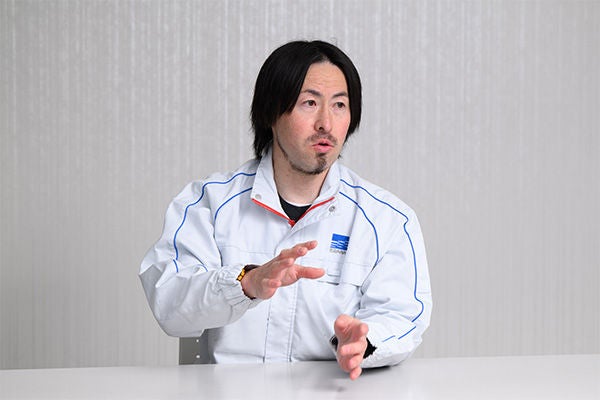
Procurement Physical Distribution Section, Production Department, Kunimi Factory EBARA FAN & BLOWER CO., LTD.
Uta:We held meetings about once a month to check progress and advance the project. I only conveyed the issues and requests of our press process at first, and after that, Matsui san took the lead.
―― Did you have anything in mind while developing the die?
Matsui:Of course, we aimed to be able to press into the desired shape, and we aimed for a die that would be easy for the on-site staff to disassemble. As I mentioned earlier, in the maintenance of the die, we disassemble everything and replace consumables used inside. I hoped to reduce the burden on the on-site staff as much as possible. Additionally, EBARA Group has multiple types of press machines, and we made it usable in a general way with those. Isn't this a unique advantage of in-house production?
The Value of the Data and Potential for Nurturing the Next Generation
―― How do you feel about the significance of this initiative?
Matsui:As I mentioned earlier, it is common to use dies developed externally for pressing. By producing in- house as we did, the know-how will remain with EBARA. Only by accumulating that know-how can we challenge improvements such as thinking of dies that realize more advanced processing. Given the reality that the number of die manufacturers is decreasing in Japan, it is very important for us to cultivate the know-how to design and develop ourselves.
Uta:What was significant in our collaboration with EMTAC was that we could make decisions one by one based on detailed data. For example, regarding the reduction of press processes this time, there was a sense on-site based on experience that we might be able to reduce one process, but EMTAC adds data support to that. That's why we were able to take action. Having such data will likely become important for employee development in the future, don't you think? In the past, it was often about learning while doing, but with labor time being limited due to work-style reform, I believe it is important to show data to convey insights and skills to the next generation more quickly. Especially for the younger generation, there is a tendency to feel convinced when there is supporting information, so I believe it is important in that regard as well.
Matsui:Moving forward, we plan to apply the know-how gained from this initiative to the pressing operations at our other group bases, including Fujisawa and Italy. In addition, EMTAC is supporting the resolution of various on-site issues, not just the reduction of press man-hours at Kunimi Factory. We hope to steadily achieve results in that regard as well.
Introducing EBARA FAN & BLOWER’s Kunimi Factory
We manufacture general-purpose fans used in air conditioning systems for buildings and commercial facilities, with nearly 120 employees working here. In recent years, we have been focusing on 5S (Sort, Set in order, Shine, Standardize, Sustain) aiming for a clean factory, and we have set aside time twice a month for all employees to clean and organize, aiming for an environment where employees can work comfortably and want to work here. In summer, we hold a summer festival, and many local people participate. We also accept high school students for workplace experience, becoming a base rooted in the community.