






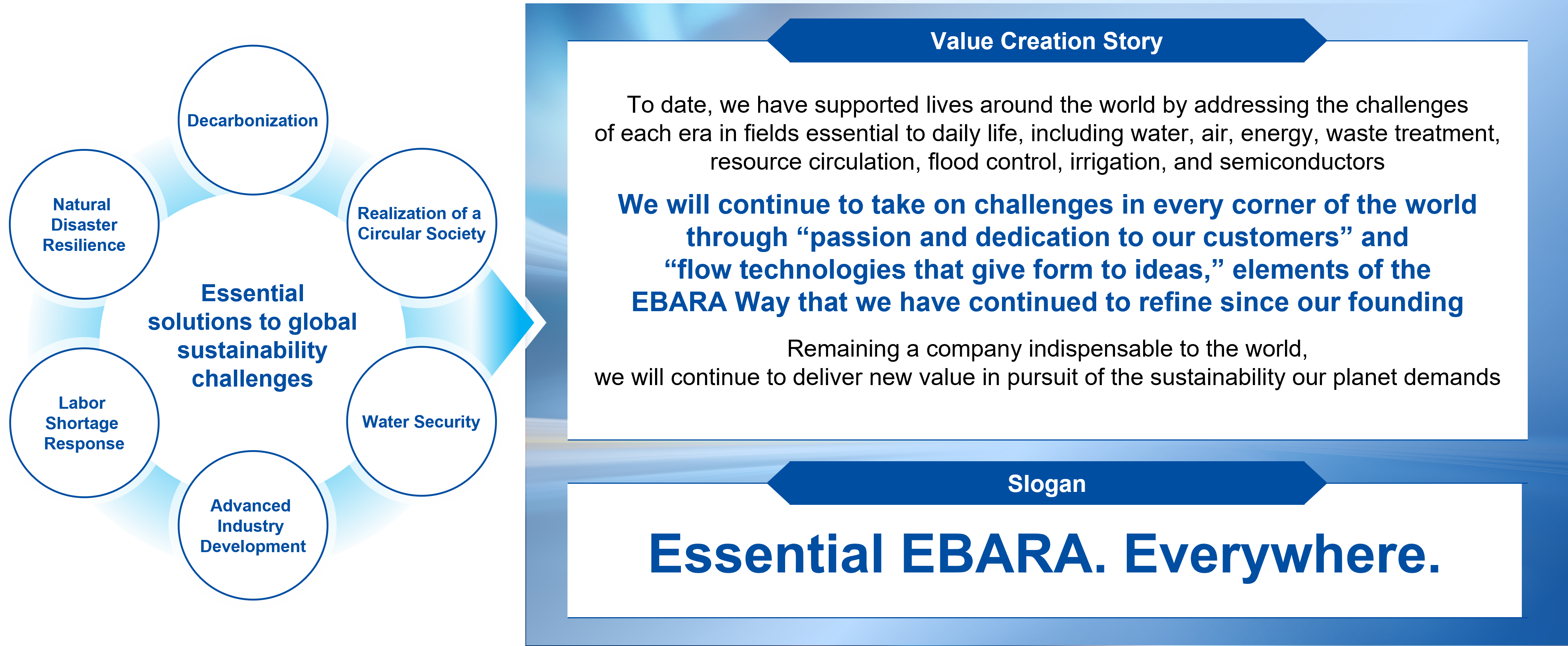
We have formulated our long‑term vision for fiscal 2035, E‑Vision 2035, and established the following value creation story and slogan.
Value Creation Story and Materiality
Value Creation Story Toward 2035
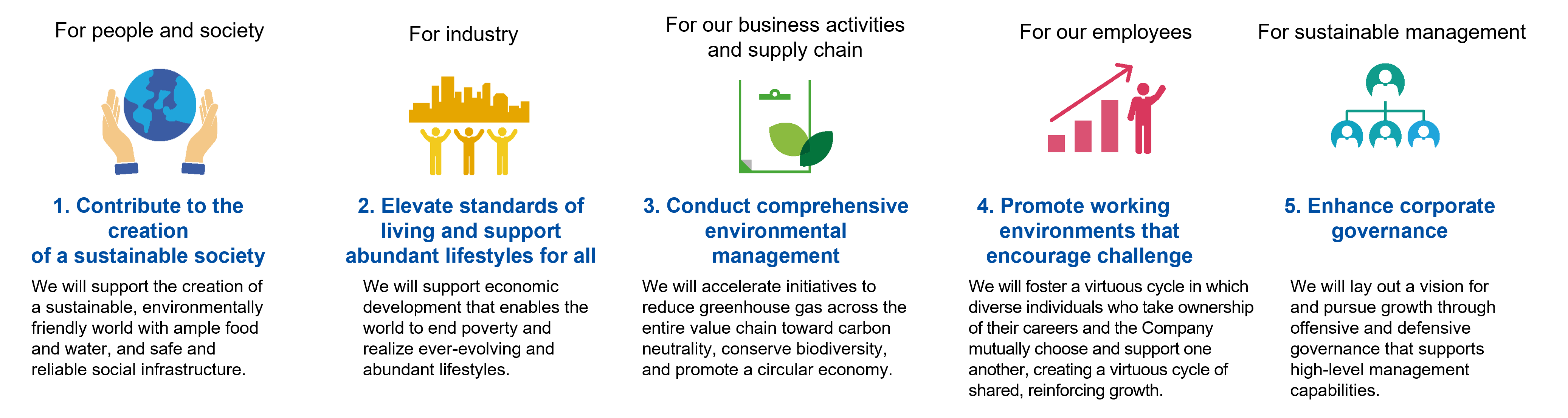
Five Material Issues
We view the creation of social and environmental value through initiatives related to our five material issues as a cycle that directly drives the growth of our economic value. This is the essence of the sustainability-oriented management our Group aims to achieve, and we are committed to putting it into practice.
Materiality Determination and Review Process
Steps 1–3 represent the process we used in 2020 when we first identified our material issues for E‑Vision 2030.
For E‑Vision 2035, we conducted an additional review as Step 4 and confirmed that these material issues remain valid toward 2035. This conclusion was approved by the Board of Directors.
Materiality Indicators and Targets
E-Plan 2028 Non-Financial KPIs and Targets (All Items)
| Material Issues | Social & Environmental Value Provided in 2035 | KPIs | Targets (2028) | |
|---|---|---|---|---|
1. Contribute to the creation of a sustainable society |
Deliver water to 800 million people*1 | (Building Service & Industrial Company) Water supply status |
75% (Achievement rate against the value to be delivered in 2035) |
|
| Protect people’s lives and livelihoods from flood risks caused by climate change | (Infrastructure Company) Equivalent watershed area for inundation avoidance |
Approx. 7,800ha*2 (2026-2028 cumulative) |
||
| Lead the energy transition toward decarbonization | (Energy Company) Share of orders for sustainability-related*3 projects (products business) |
20% | ||
Implement technologies in society that contribute to CO2 reduction and the circular use of carbon resources |
(Environmental Solutions Company) Orders received for ICFG®/EUP® (gasification) |
1 order or more | ||
| (Environmental Solutions Company) Progress in the development and social implementation of ICFG® technology (oil conversion) |
Establishment of oil conversion technology | |||
| Reduce greenhouse gas by an amount equivalent to approximately 250 million tons of CO2 (total for 2023-2035)*4 | GHG (CO₂-e) reductions enabled by our products and services*5 | 64 million t-CO2 (total for 2023-2028) |
||
| Responsible procurement | CSR procurement compliance rate among key suppliers | 75% | ||
2. Elevate standards of living and support abundant lifestyles for all |
Achieve zero downtime to ensure the uninterrupted flow of comfortable living worldwide | (Building Service & Industrial Company) Growth rate of the number of units connected to remote monitoring services (EBARA Maintenance Cloud, RISSA, RISS, JES) |
50% or more (CAGR 2025-2028) |
|
| Support higher integration and sustainability in semiconductor manufacturing, and contribute to the advancement of an AI-empowered society*6 | (Precision Machinery Company) Semiconductor miniaturization: Development progress rate of elemental technologies compatible with 7Å-generation semiconductor manufacturing technologies |
75%*7 | ||
3. Conduct comprehensive environmental management |
Minimize the environmental impact of our business activities |
CDP score (climate change) | Maintain a Leadership level rating (A or A-) | |
| GHG emissions Scope 1 & 2 (CO2-e) | 46% reduction (vs. 2018) |
|||
| GHG emissions Scope 1 & 2 (CO2-e) per unit of revenue (emissions intensity) for major businesses | 66% reduction (vs. 2018) |
|||
| GHG emissions Scope 3, Category 11 (CO2-e) | 20% reduction (vs. 2021) |
|||
| Water consumption intensity | Ongoing improvement | |||
| Rate of waste recycling in Japan | Maintain 95% or higher | |||
4. Promote working environments that encourage challenge |
Promote the active participation of diverse global talent |
Ratio of women (consolidated) | 11.0% | |
| Nationality diversity indicator (consolidated) | Level in line with global peers | |||
| Percentage of women in management positions (Japan) | 11.0% | |||
| Percentage of men taking childcare leave (Japan) | 100% | |||
| Percentage of employees with special needs (Japan: non-consolidated & 5 Group companies) |
2.80% | |||
Promote a safe, secure, and healthy workplace environment |
Global Engagement Survey Score | 85 | ||
| Number of fatalities and serious incidents | 0 events | |||
| Certification as a Health & Productivity Management Outstanding Organization*8 (Japan) | Obtain certification | |||
5. Enhance corporate governance |
Strong corporate governance |
Conduct Board effectiveness evaluations and address identified issues | Chair interviews; self- and peer evaluations; Chair evaluations; identification of issues and reforms, etc. | |
| Provide support activities for Independent Directors | Independent Directors’ meetings; site visits; study sessions, etc. | |||
| Facilitate dialogue between Independent Directors and stakeholders | Ongoing dialogue | |||
Footnotes:
*1 Updated from the value creation target under E-Vision 2030: “Deliver water to 600 million people.”
*2 An estimate based on the total capacity of drainage pumps targeted for new and replacement orders between 2026 and 2028, indicating the area that could be kept below the floor-level flooding threshold (50 cm) during 24-hour continuous operation (equivalent to approximately 13% of Tokyo’s 23 wards).
*3 CO₂, ammonia, hydrogen, SAF, etc.
*4 Updated from the value creation target under E-Vision 2030: “Reduce GHG emissions by an amount equivalent to approximately 100 million tons of CO₂ equivalents.”
*5 Calculated as the amount of GHG emissions that can be reduced before and after installation of our products, converted to CO₂ equivalents. Includes certain contributions to emissions reductions calculated with reference to WBCSD guidance.
*6 Update to “Challenge 14Å,” the value provision targeted under E-Vision 2030.
*7 Based on a 2035 target scenario in which the development of 7Å-generation semiconductor manufacturing technologies has been completed and commercialized and is supporting enriched lives in society.
*8 Maintain designation as a “White 500” Certified Health & Productivity Management Outstanding Organization, organized by Japan’s Ministry of Economy, Trade and Industry (METI) and the Health & Productivity Management Council, and obtain recognition as a Health & Productivity Stock Selection.


