





Global

Environmental Management

Environmental Governance Structure

The Group aims to enhance social and environmental value as well as economic value by continuously contributing to the resolution of social issues, including the SDGs, through our business. With the aim of enhancing our corporate value over the medium- to long-term, we practice sustainability management, which is based on the pillars of taking aim at environmental issues (E), fostering bonds with society (S), and enhancing governance (G).

The Board of Directors incorporates sustainability-related topics, such as climate and nature-related issues, into its agenda and provides feedback to the Sustainability Committee on the results of these discussions. The Sustainability Committee, chaired by the President, Representative Executive Officer, explores how the Group can contribute to building a sustainable society and environment through its business operations, while continuously enhancing corporate value.
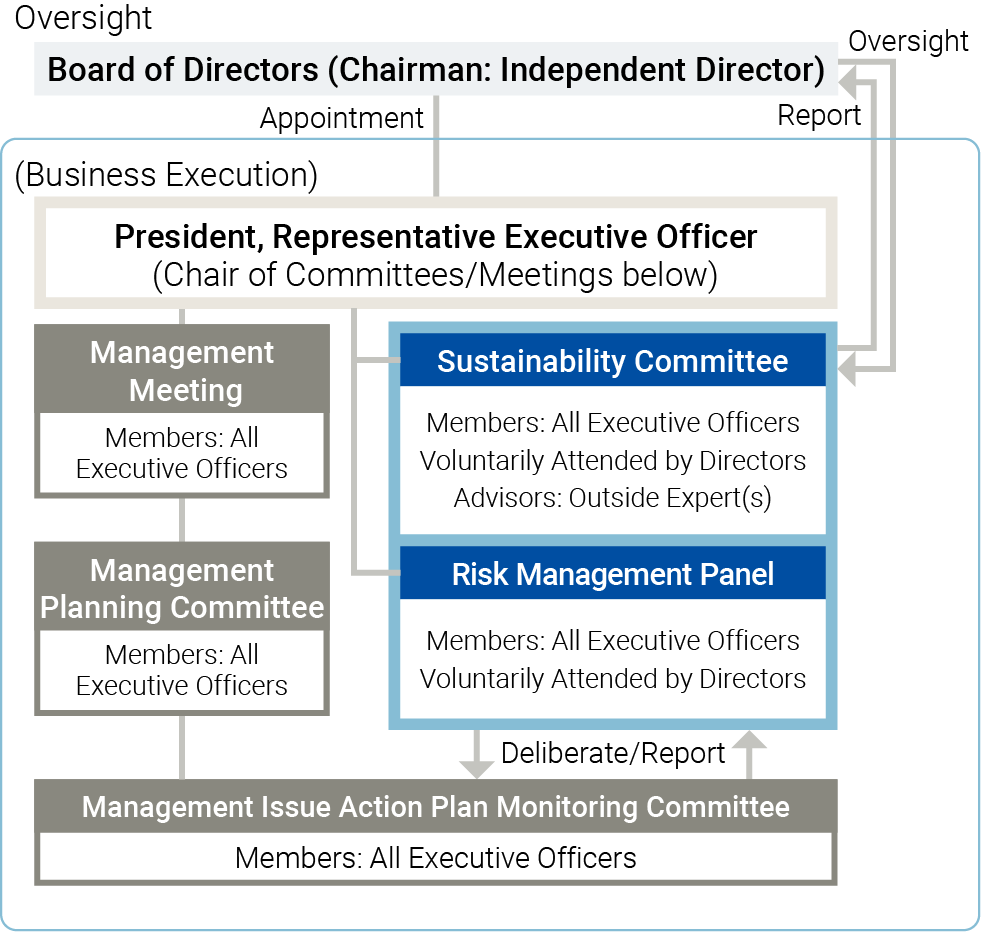
Environmental Governance Structure

Our Approach to the Environment

Global environmental challenges, such as climate change, resource depletion, and biodiversity loss, are complex and interconnected. Addressing these issues requires action toward decarbonization, a circular economy, and a nature-positive approach. Our business is both impacted by these challenges and uniquely positioned to contribute positively. With this understanding, we have established the EBARA Group Environmental Policy.

EBARA Group Environmental Policy

The EBARA Group aims to support the sustainable development of countries around the world and realize safe and reliable living and abundant lifestyles by providing products and services relating to water, air and the environment. We commit to implementing the following activities while pursuing our aims.

  1. Contribute to decarbonization by maximizing the use of renewable energy and reducing greenhouse gas emissions throughout our value chain.
  2. Contribute to the creation of a circular society through business activities. Conserve and recycle raw materials and energy, reduce waste and find ways to turn waste back into resources.
  3. Conduct business with awareness of how our products and services impact nature, including water, throughout their life cycle, and take action to preserve biodiversity to create a society that exists in harmony with nature.
  4. Actively disclose information and communicate with our stakeholders to foster trust.
  5. Establish environmental management systems, set and implement environmental objectives, and strive for continuous improvements.
  6. Comply with domestic and international laws, regulations, and internal regulations, and sincerely respond to the demands of society.

March 27, 2025
Shugo Hosoda
Director, CEO & COO
President, Representative Executive Officer

Strategies for Reducing Environmental Impact
— Contribute to the Creation of a Decarbonized Society

Please see more at the link below.

Strategies for Reducing Environmental Impact
— Contribute to the Creation of a Circular Society

Our Awareness and Approach

Effective resource utilization is a key issue for the Group, as the amount of waste generated reflects how efficiently resources are used and is closely tied to our business activities. Therefore, we monitor the amount of waste generated at all of our manufacturing sites. Waste is recycled through appropriate treatment, but to maintain a high recycling rate, it is essential to thoroughly sort waste at the time of discharge and select reliable disposal contractors. Through these measures, we are contributing to creating a circular society.

Measures for Waste Reduction

Waste generated by the Company’s procurement activities includes film-based plastics and wooden pallets. At the Fujisawa Plant, film-based plastics were previously processed into solid fuel as industrial waste. However, starting in 2024, we began selling them as raw materials for recycled plastic bags. These bags are sold commercially as eco-friendly plastic bags and are used as designated trash bags at the Fujisawa Plant. In addition, the Procurement Department is moving forward with measures to replace wooden pallets with plastic pallets, which are being evaluated for reuse as raw materials for recycled plastic after use.

Compliance with the Plastic Resource Circulation Act

In Japan, the Plastic Resource Circulation Act began being enforced in April 2022, and EBARA surveyed its actual plastic waste discharge accordingly. Our main types of waste discharge plastic are packaging and cushioning materials used in logistics, scraps of resin and packing used in product manufacturing and other consumer goods and stationery used in our offices. The amount of waste plastic that the Company discharged in 2024 was approximately 474 tons, classifying us as a large volume generator. To reduce emissions and increase recycling resources, we will organize the flow of waste, including waste plastic, and engage in the following activities.

  • Shift from waste matter to waste with value
  • Discharge waste that can be recycled at disposal contractors
  • Confirm the quantities of each item in the flow of waste and establish management indicators

Strategies for Reducing Environmental Impact
— Contribute to the Creation of a Society in Harmony with Nature

Our Awareness and Approach

Sustainable water resource management is an extremely important topic for the EBARA Group. To address this, we promote efficient water use and are committed to maximizing recycling and reuse. Additionally, wastewater discharged into rivers and oceans must undergo appropriate treatment to minimize pollutants. These efforts help reduce our dependence and impact on water resources, an essential form of natural capital, while supporting the long-term sustainability of our business and, from a broader perspective, contributing to the restoration and regeneration of nature.

Acquired “Water Cycle ACTIVE Company” Certification

The Company has been certified as a Water Cycle ACTIVE Company by the Cabinet Secretariat’s Headquarters for Water Cycle Policy Secretariat. This certification is given to companies that have achieved results that contribute to water circulation within the last three years and have been recognized under the Water Cycle Company Registration/Certification Program established by the Secretariat in fiscal 2024.

In the Water Quantity & Quality Category*¹, the Fujisawa Plant was certified for setting and adhering to internal standards that are stricter than legally mandated effluent standards, and in the Human Resources & Funds Category*², for cooperating with cleanup efforts at rivers and streams throughout Japan.

*1. Evaluated contributions to water circulation throughimprovements in water quantity and quality
* 2. Evaluated contributions to water circulation through humanresources, funds, and equipment, etc

Green Procurement

EBARA Corporation issued these Green Procurement Guidelines in November of 2003. At EBARA, we believe it is one of our responsibilities to provide products and services that contribute to the important social issue of environmental conservation. In order to fulfill this responsibility we must reduce the burden the creation of our products places on the environment as much as possible. We acknowledge that not only must we take action on a company-level, but we must look at our entire supply chain and ask our suppliers’ to work with us to promote the procurement of green raw materials. To accomplish these goals, EBARA Corporation does the following.

  1. We promote product designs with care for the environment and conduct green procurement in accordance with the procurement specifications derived from the design pursuant to the design guidelines for the environment, internal standards of EBARA.
  2. We set Requests to All Suppliers in light of environmental considerations for all suppliers that provide products to EBARA.
  3. We purchase stationery, office machines, and OA/IT equipment that is eco-friendly. In addition, we execute green procurement considering social concerns such as FSC certification given to products made from sustainably-managed forest resources.
  4. We choose suppliers based on the results of the Suppliers' Environmental Management Survey, in addition to price, quality, and delivery period.

For further information on what we ask of our suppliers, please refer to the EBARA Corporation Green Procurement Guidelines:

EBARA Corporation Green Procurement Guidelines Ver.4

Filename
GreenProcurementGuidelines_ver4_jp_r1.pdf
Size
348 KB
Format
application/pdf

Biodiversity

We at EBARA are dedicated to the protection of biodiversity in our environment. We implement the “EBARA Group Biodiversity Guidelines” and develop awareness about the importance of biodiversity through engaging our employees with experiences in nature and in-house education.

EBARA Group Biodiversity Guidelines

EBARA Group believes that the conservation of biodiversity is one of our social responsibilities and have implemented the following guidelines.

  1. We consider the conservation of biodiversity an important management issue and make an effort toward conservation.
  2. We promote employee awareness of the importance of biodiversity conservation through opportunities such as environmental education and experiencing nature.
  3. We seek to gain a better insight into the relationship between corporate activities and biodiversity and reflect this insight in the Group's drive to conserve biodiversity.
  4. We contribute to the conservation of biodiversity through corporate activities that are guided by the principles of resource conservation, energy conservation and biodiversity-aware outsourcing.

Please see "3. Meeting the Needs of Employees" under our Social Contribution section to learn more about initiatives related to biodiversity.


Environmental Risk Management

Our Vision

The Group’s environmental risks refer to adverse environmental impacts, legal sanctions due to violations of laws and regulations, and adverse effects on our reputation. These environmental risks are appropriately managed through an environmental management system.

Main Environmental Risks
Legal and regulatory risk Violations of environmental laws or regulations may result in legal consequences such as fines, lawsuits, or suspension of business operations.
Environmental pollution risk Improper waste, wastewater, or gas emissions management may pollute the air, water, or soil.
Reputation risk Inadequate response to environmental issues may lead to public criticism and loss of customer trust.
Resource depletion risk Poor management of resources such as water may accelerate depletion, potentially increasing production costs and reducing competitiveness.

Environmental Education

The EBARA Group has a responsibility to prevent environmental pollution associated with various business activities and to provide environmentally responsible products to customers. In order to do so, we must ensure that all employees have a high awareness of environmental conservation. At EBARA, we hold various environmental education programs.

In addition, we offer expert environmental education on topics such as waste risk management and recent revisions to laws and regulations. At Ebara, we focus on “fostering a high environmental awareness” and “offering timely education regarding rules and required knowledge” to ensure that environmental management is carried out effectively.

Environmental Audits

Environmental auditors perform an environmental audit to check compliance with environmental laws and regulations, implementation status of preventive measures against environmental pollution, and the progress of promotion of environmental management activities.

Type of audit Contents
Internal environmental audit
(First-party audit)
Independent audit conducted by the office or district
Corporate environmental audit
(Second-party audit)
Audit of each company of the EBARA Group by EBARA Corporation Environmental Management Promotion Section
Examination by an external certification body
(Third-party audit)
Environmental audit of the management systems by an external certification body

Environmental Reviews

Construction of new production or welfare facilities or the restoration or removal of such facilities may cause various environmental impacts such as waste, wastewater, vibrations, and noise. At EBARA, we proceed with construction by performing a multiple check at the construction planning stage of facilities: we assess environmental impact at the stages of installation and operation, and check legal compliance with environmental laws and the Industrial Safety and Health Law.

Survey on Regional Water Stress

In recent years, interest in water risks has risen due climate change and other environmental issues increasing the frequency of droughts, floods, or other water-related disasters.

We face the risk of operations being affected by water resource shortages stemming from climate change. Therefore, we must use water efficiently and understand whether water usage is appropriate for business activities. We regularly use Aqueduct 4.0, a tool made available by the World Resources Institute that provides global maps and information indicating water risks worldwide, to identify sites in water-stressed areas.

In the survey conducted in 2022, we found that eight of our sites are located in high-risk areas, and their water intake was 219 ML, accounting for 21% of the Group’s total water intake. Going forward, we will examine the local water supply and drainage management at sites located in such high-risk areas, seek to understand the risks associated with water intake and discharge systems, and then implement measures to reduce risks.

  • A survey was conducted on water risks in business activities at sites with annual water consumption of 1,000 m3 or more in 2022.
  • We then compared the water use of 37 sites in Japan, China, Indonesia, the Philippines, Singapore, Vietnam, Thailand, Malaysia, Korea, Taiwan, Saudi Arabia, Italy, Germany, the United States of America, and Brazil against the regional risk level to identify high-risk areas.

Water Risk Level Survey Results

Filename
water_risk_2021(jp).pdf
Size
350 KB
Format
application/pdf

Metrics and Targets

The EBARA Group positions its response to the five material issues identified in the long-term vision E-Vision 2030 as a key management topic for a sustainable society. In the activities outlined in our Environmental Policy, such as a decarbonized society, a circular society, and a society in harmony with nature, we aim to make social contributions through our business in order to achieve our 2030 goals.

Matrix&Target

EBARA Group FY2030 Environmental Targets

The EBARA Group has formulated the EBARA Group FY2030 Environmental Targets, which summarizes the ideal state of 2030 in terms of the environment, in order to carry out manufacturing with the utmost consideration for reducing environmental impact.

FY2030 Targets

  1. EBARA Group will reduce total greenhouse gas emissions from our business activities within the Group by 55%* compared to FY2018.
  2. EBARA Group will maximize the reasonable use of water in our business activities within the Group and ensure that the basic unit of water use does not exceed the previous year’s value.
  3. In order to contribute to resource recycling and the construction of a circular economy society EBARA Group will maintain a waste recycling rate of 95% or more in Japan.

*With the Japanese government target being raised in 2021, we have also reviewed and revised our original target from 26% reduction to 55% in 2022 compared to FY2018.

In addition, recognizing that climate change countermeasures are an important issue common to the entire globe, the EBARA Group has set targets by working to reduce greenhouse gas emissions throughout the value chain from the view point of the life cycle of products and services. 

2024 Achievements and Evaluation

Goal FY2024 Results FY2024 Achievements Future Initiatives
1 EBARA Group Scope 1 & 2 GHG emissions:
141,000 tons emitted 
Reduced 49.1% compared to FY2018
  • Energy-efficient operation of facilities
  • Expanded procurement of low-CO2 electricity
  • Introduction of solar power generation facilities
  • Timely upgrades of facilities with high energy consumption, such as industrial furnaces and transforming equipment
  • Expanding electrification and low-carbon procurement of electricity
  • Expanding installation of solar power generation equipment
  • Utilization of carbon pricing
2 Water use revenue intensity:
0.108km3/100 million yen
Improvement from FY2023
  • Reuse of water in ultrapure water production
  • Utilization of rainwater
  • Identification of and implementation of countermeasures against leakage points based on water usage monitoring results
  • Implementation of measures for industrial water recycling and against water leakage
  • Promotion of water conservation by updating water usage equipment and revising water usage processes
3 Material recycling rate:
Achieved 97.7% in Japan, exceeding the target
  • Promote visualization of the amount of reusable waste via thorough waste separation.
  • Survey of waste plastic emissions
  • Review of waste management indicators
  • Improvement of the recycling rate by thoroughly separating waste and revising waste processing contractors
  • Confirmation of the effectiveness of waste management indicators

Approach to Environmental Management

The EBARA Group implement environmental management by setting goals for "on-site activities" aimed at preventing environmental accidents and "contributions through the provision of products and services" to address environmental issues outlined in our environmental policy.

The corporate division provides support to promote these activities and discloses the results to the stakeholders

Approach to Environmental Management

ISO 14001 Certification Status

As a part of our efforts to tackle the material issue of comprehensive environmental management identified in E-Vision 2030, we are working to obtain ISO 14001 certification for Group companies with manufacturing and maintenance plants. As of March 1, 2025, 8 domestic and 31 overseas Group companies have received ISO 14001 certification. Twenty-eight of the 29 overseas Group companies planning to acquire certification by 2025 are certified, plus 3 companies have voluntarily acquired certification. In the future, we plan to acquire ISO 14001 certification at all Group companies with manufacturing and maintenance plants by the end of 2025. In addition, for new companies joining the Group, after confirming their current environment management system, if they have not yet acquired ISO 14001 certification, we will formulate and implement a plan to acquire the certification.

ISO 14001 Certified Site Details

Filename
2025_ISO14001_en.pdf
Size
597 KB
Format
application/pdf

For sustainability inquiries, please contact us here